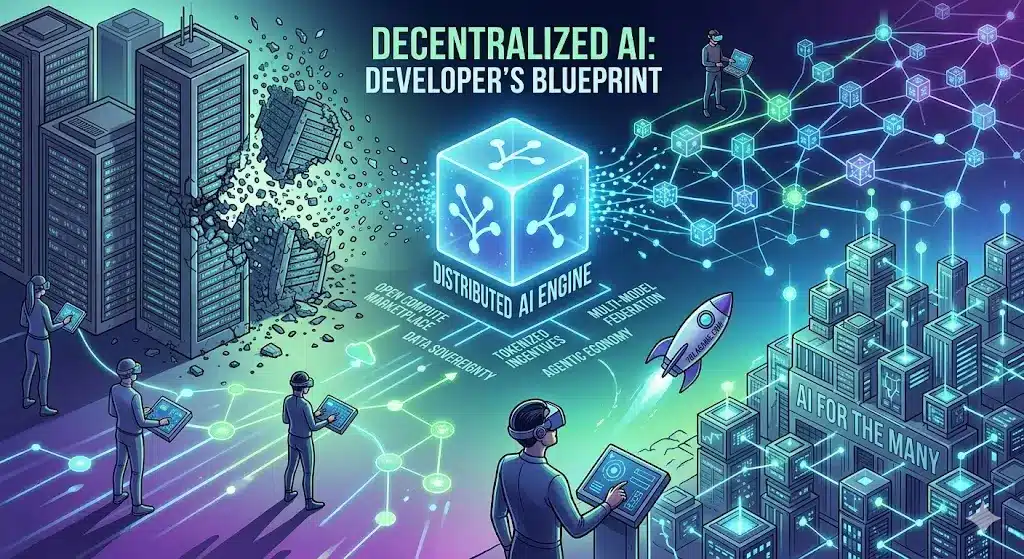
The era of building AI applications exclusively through centralized, closed APIs is hitting a wall. Massive API rate limits, unpredictable pricing tiers, compute shortages, and strict vendor lock-ins are forcing a structural paradigm shift.
Enter Decentralized AI (DeAI).
What started as a theoretical framework has quickly evolved into an enterprise-grade production infrastructure. For software developers, engineers, and system architects, DeAI isn’t just a buzzword—it represents a fundamental recalculation of how machine learning models are trained, hosted, orchestrated, and commercialized.
Here is what you need to understand about the decentralized AI ecosystem and how it impacts your development pipeline.
The Core Pillars of the DeAI Stack
Decentralized AI isn’t a single monolithic technology. Instead, it is modular infrastructure built to bypass massive server farms owned by big tech conglomerates. The modern DeAI stack is built on three main layers.
+-------------------------------------------------------------+
|               Agentic Layer (Autonomous Economic Actors)    |
|               e.g., Artificial Superintelligence (ASI), Sky |
+-------------------------------------------------------------+
                              |
                              v
+-------------------------------------------------------------+
|               Intelligence & Incentive Layer (Open Models)   |
|               e.g., Bittensor (TAO) Subnets                 |
+-------------------------------------------------------------+
                              |
                              v
+-------------------------------------------------------------+
|               DeCompute Layer (Distributed Hardware Rails)  |
|               e.g., Render Network, Akash Network           |
+-------------------------------------------------------------+
1. Decentralized Compute (DeCompute)
At the bottom of the stack sits raw hardware. Compute remains the ultimate bottleneck in artificial intelligence development. Global GPU demand frequently outstrips available cloud supply, leaving independent developers priced out.
DeCompute networks (such as Render Network and Akash Network) function as distributed marketplaces for raw graphics processing unit capacity. By connecting idle processing power from independent data centers, crypto miners, and enterprise clusters worldwide, these systems let you rent exact hardware profiles programmatically. You scale up workloads during intensive inference or training bursts, paying only for the exact resources consumed without signing long-term cloud service agreements.
2. Intelligence Markets & Incentive Networks
Instead of hosting a private model on a centralized cloud instance, platforms like Bittensor (TAO) treat machine intelligence as an open, competitive market.
Bittensor operates using a distinct subnet architecture. Each subnet incentivizes different machine learning tasks, from code generation and text-to-image processing to complex web scraping. Nodes (miners) compete to provide the absolute highest quality output for a given query, while validators constantly grade and log their performance. As a developer, this means you can tap into massive, self-optimizing open-source networks to query highly sophisticated, fine-tuned models via decentralized APIs.
3. Agentic & Autonomous Layers
The conversation around AI agents has quickly moved past standard wrapper scripts and basic tool-calling demos. True decentralized agents operate as standalone economic entities.
By integrating cryptographic transaction layers and decentralized identities (such as the unified Artificial Superintelligence Alliance ecosystem), software agents can hold digital wallets, manage operational budgets, pay other micro-agents for data pipelines, and execute complex on-chain tasks without direct human oversight.
Why Developers Are Moving Away From Centralized APIs
Relying completely on black-box, centralized AI ecosystems presents clear operational liabilities for production-level software:
- Model Drift and Opaque Pipelines: Centralized providers frequently update weights or adjust alignment parameters under the hood without warning. An API call that outputs clean JSON data today might return messy, unformatted text tomorrow.
- Data Privacy & Exploitation: Inputting proprietary corporate data or sensitive user information into closed APIs often means surrendering your data to train a competitor’s next-generation foundational model.
- Zero Architectural Sovereignty: If a provider suffers a catastrophic data center outage or unilaterally bans an API account, the dependent software application goes down instantly.
DeAI patterns address these issues directly. Systems utilizing Zero-Knowledge Machine Learning (zkML) allow developers to execute AI inference off-chain and submit a cryptographic proof to an open ledger, verifying that the calculation was performed perfectly by the correct model without exposing raw data inputs.
How to Adapt Your Developer Stack
Transitioning to decentralized AI doesn’t mean rewriting your code from scratch. It is about integrating distributed infrastructure into your existing pipelines.
Modern GPU Orchestration
Instead of locking your code into proprietary machine learning instances, deployment pipelines are increasingly migrating toward distributed, containerized environments. Below is an example of a Kubernetes resource configuration designed to programmatically request a dedicated GPU from a decentralized compute provider:
YAML
apiVersion: resource.k8s.io/v1alpha3
kind: ResourceClaimTemplate
metadata:
  name: deai-h100-request
  namespace: prod-ai-cluster
spec:
  spec:
    devices:
      requests:
        - name: high-perf-gpu
          exactly: 1
          deviceClassName: h100.decentralized-compute.com
          sharingStrategy: MPS
Navigating Key Development Challenges
While DeAI provides unparalleled flexibility, working with distributed networks introduces unique architecture challenges that you must account for in production:
| Challenge | Impact on Apps | Modern DeAI Solution |
| Verification of Work | Bad actors running nodes could return cheap, hallucinatory garbage text to save power. | Proof of Useful Work: Networks use consensus algorithms and automated validator cross-checking to penalize dishonest nodes. |
| Model Weight IP | Running your proprietary weights on third-party hardware risks model theft. | Trusted Execution Environments (TEEs): Hardware-level secure enclaves block the node operator from inspecting system memory. |
| Network Latency | Querying a geographically dispersed mesh network can slow down fast real-time applications. | Edge DeAI: Pushing smaller, highly optimized models down to local consumer devices and caching queries regionally. |
Summary: The Next Developer Playground
Decentralized AI is breaking open the closed-source monopoly. The emergence of scalable compute marketplaces, open incentive structures like Bittensor, and auditable agent frameworks gives developers structural independence over their software.
By shifting your architecture toward composable, open-weight models, secure edge inference, and distributed hardware arrays, you ensure your software remains fast, secure, and entirely within your own control.