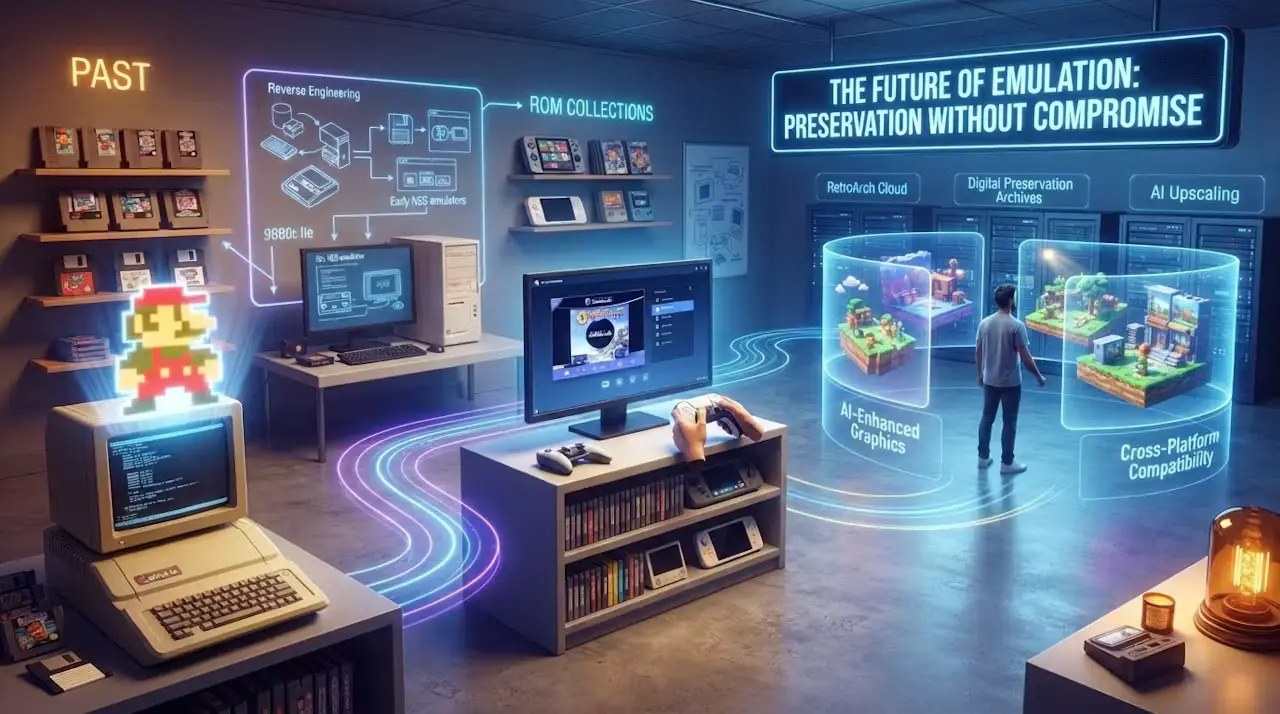
Video games are a cornerstone of modern culture, yet the medium faces an unprecedented crisis of extinction. According to a landmark study by the Video Game History Foundation, an alarming 87% of classic video games released in the United States are critically endangered and commercially unavailable.
Unlike books, films, or music—which benefit from decades of established archival infrastructure and legal frameworks—video games are tied to rapidly degrading physical media and proprietary hardware. When old consoles break down and server connections shut down, entire eras of digital history risk vanishing forever.
Enter emulation: the technological bridge keeping classic gaming history alive. This article explores the evolution of video game emulation, its vital role in digital preservation, the ongoing legal battles, and what the future holds for keeping our interactive heritage playable.
What is Video Game Emulation?
At its core, emulation is the process that allows a computer system (the host) to behave like another, entirely different system (the target). Instead of relying on original, aging hardware—such as a 1980s arcade cabinet, a Super Nintendo, or an original PlayStation—an emulator software translates obsolete machine code in real-time so that classic games can run smoothly on modern PCs, smartphones, and current-gen consoles.
Why Hardware Preservation Alone Fails
- Component Degradation: Capacitors leak, plastic shells brittle, and magnetic storage media (floppy disks, cartridges, and optical discs) rot over time.
- Technological Obsolescence: Relying solely on physical preservation satisfies purists short-term, but hardware inevitably fails permanently.
- Accessibility Barriers: Original cartridges and vintage equipment have inflated in collector markets, making physical access prohibitively expensive for everyday players and historians.
A Brief History of Emulation: From Hobbyist Roots to Industrial Necessity
The history of emulation mirrors the rapid evolution of computer processing power. What started as underground experiments by computer scientists and hobbyists in the mid-1990s has grown into a sophisticated field of software engineering.
1. The Arcade Savior: MAME
Launched in 1997, the Multiple Arcade Machine Emulator (MAME) revolutionized preservation. Creator Nicola Salmoria designed MAME to document the hardware of vintage arcade coin-ops and protect them from rust and time. Because countless arcade developers went bankrupt or dissolved decades ago, MAME became the ultimate digital archive for games that otherwise would have been lost entirely.
2. The Console Era Emulators
As desktop processors grew stronger, independent developers built accurate software architecture for home consoles:
- NES and SNES Emulators: Projects like Nestopia and ZSNES proved that 8-bit and 16-bit systems could be faithfully replicated down to their specific audio chips and graphical quirks.
- The 5th and 6th Generation Leap: Emulating CD-based and 3D systems (PlayStation, Nintendo 64, Dreamcast, and PS2) introduced massive architectural hurdles, requiring complex high-level emulation (HLE) and low-level emulation (LLE) techniques.
The Legal Gray Area: Preservation vs. Intellectual Property
Few topics in tech are as legally contentious as video game emulation.
- The Publisher Perspective: Major corporations—most notably Nintendo—defend their intellectual property fiercely. Unauthorized distribution of ROMs (Read-Only Memory dumps) and ISOs constitutes copyright infringement. Companies argue that protecting IP rights prevents market devaluation, especially as retro compilations and digital storefronts become lucrative business ventures.
- The Preservationist Dilemma: Preservation groups argue that current commercial channels fail to make the vast majority of gaming history accessible. When digital storefronts close or publishers refuse to reissue titles, emulation remains the only viable mechanism to study, archive, and experience these cultural artifacts.
Progressive shifts are occurring. Companies like Microsoft have championed built-in backward compatibility, utilizing legal emulation environments to let modern Xbox consoles run original Xbox and Xbox 360 game discs natively. Similarly, subscription models and digital initiatives (such as Sega Forever and various classic collections) attempt to meet consumer demand legally.
The Future of Emulation and Playable Preservation
As gaming technology marches forward into complex ecosystems—including server-dependent live service games, virtual reality, and advanced ray-tracing architectures—the definition of emulation is evolving:
- Modern Console Emulation: Recent breakthroughs by community developers targeting modern architectures (such as advanced Nintendo Switch, PlayStation 4, and early PlayStation 5 experimental tools) prove that emulation continues to chase cutting-edge hardware.
- Beyond Visual Accuracy: Future preservation focuses on playable preservation—recreating netcode, simulating shut-down online servers, and documenting proprietary middleware so future historians can experience games interactively rather than as static files.
- Institutional Archiving: Libraries, national archives (like the National Library of Spain), and museum initiatives are increasingly recognizing digital games as vital cultural heritage, partnering with technologists to establish legitimate, sanctioned preservation pipelines.
Conclusion
Emulation is much more than a tool for playing retro games on modern hardware—it is a critical cultural safeguard. Without it, an overwhelming majority of electronic entertainment risks disappearing beneath the weight of decaying media and corporate oversight. As technology advances, finding a sustainable balance between intellectual property enforcement and institutional digital preservation will determine whether the first fifty years of video game history survive for the next generation.
The Complete History of Video Game Emulation! How Emulators Changed Gaming Forever
This video provides an in-depth visual overview of how emulation has evolved across multiple console generations and highlights key preservation milestones.